

Analysis of Government data published alongside the new National Planning Policy Framework finds that 93 English local planning authorities recorded a Housing Delivery Test result below 75%, triggering a new policy consideration for certain development outside settlement boundaries. More than half are in London and the South East. In the North West, just three of 37 authorities qualify.
The Government’s new planning rules could have their greatest practical impact in some of England’s most constrained and expensive areas, according to analysis of Government data by chartered town planners at national consultancy Planning By Design.
The new National Planning Policy Framework (NPPF) took effect on 17 August 2026, replacing the December 2024 version. Its national decision-making policies became material considerations from the day of publication, meaning they now apply not only to future local plans but to planning applications and appeals already awaiting determination.
On the same day, the Government published the delayed 2025 Housing Delivery Test measurement.
Planning By Design’s analysis of the full dataset finds that, of the 301 local planning authorities with a numerical result, 93 recorded a delivery rate below 75%, while 147 fell below the 95% pass mark.
The 75% threshold now has a new significance.
Under Policy S5 of the new NPPF, certain categories of development outside settlement boundaries should be approved unless the benefits would be substantially outweighed by adverse effects. The policy expressly treats a Housing Delivery Test result below 75% as evidence of unmet housing need for the purposes of that policy.
Under the previous framework, a failing score was a route into the so-called tilted balance, a technical argument applicants had to construct and defend case by case.
The new policy changes the starting position for qualifying proposals.
The geography is the story
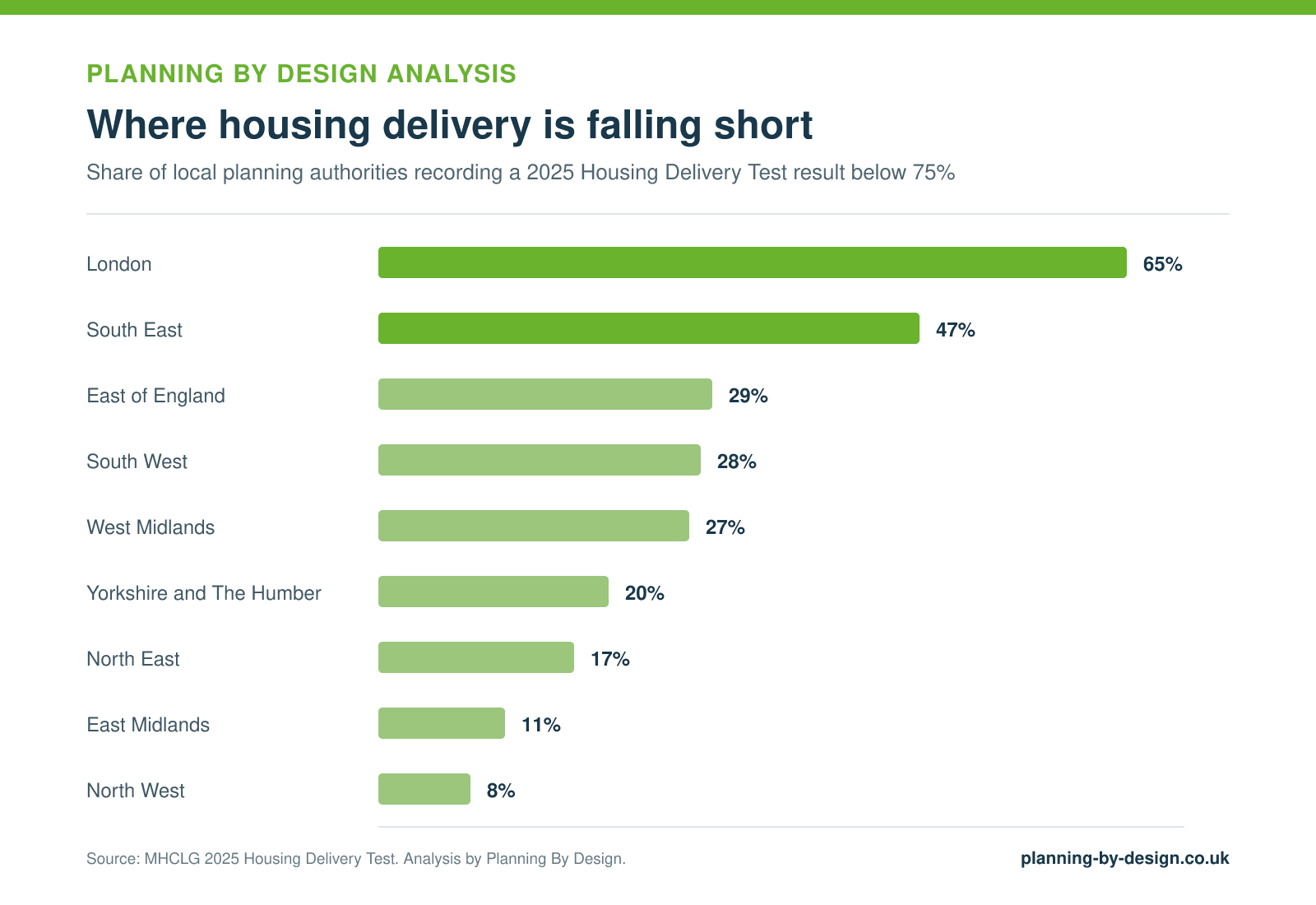
The 93 authorities with a delivery rate below 75% are not distributed evenly across England. Planning By Design’s regional analysis finds:
| Region | Authorities | Below 75% | Share |
|---|---|---|---|
| London | 34 | 22 | 65% |
| South East | 64 | 30 | 47% |
| East of England | 45 | 13 | 29% |
| South West | 29 | 8 | 28% |
| West Midlands | 30 | 8 | 27% |
| Yorkshire and The Humber | 15 | 3 | 20% |
| North East | 12 | 2 | 17% |
| East Midlands | 35 | 4 | 11% |
| North West | 37 | 3 | 8% |
Fifty-two of the 93 authorities, well over half, are in London or the South East.
The North West, with more local planning authorities than any other region outside the South East, contributes just three.
The figures challenge the instinctive reading of housing reform as primarily a Northern story.
The practical significance is greatest in the South East.
Aaron Basi, Chartered Town Planner and Head of Planning at Planning By Design, said:
“The instinctive reading of housing reform in this country is that it is aimed at the North. This data says the opposite. The councils that have crossed the threshold are overwhelmingly in the South East and London, which is where land is most expensive, most constrained and most fiercely defended.”
“There is a further twist that I think will get missed. Policy S5 governs land outside settlements. In most of London there is barely any land outside a settlement, so for the majority of those 22 boroughs the S5 route is close to academic and Policy S4 is doing the real work. The region where this genuinely changes the arithmetic is the South East: 30 authorities, a great deal of countryside, a great deal of Green Belt, and a policy that now starts from ‘should be approved’ rather than from ‘no’.”
The scale of the shortfall
Collectively, the 93 authorities delivered 167,600 homes against a requirement of 326,300 over the three years to March 2025, a shortfall of close to 159,000 homes and a combined delivery rate of 51%.
Thirty-eight authorities delivered less than half of what was required of them. Ten delivered less than 30%. The lowest results were recorded by the City of London at 4%, and Castle Point and Portsmouth, both at 11%.
Across all 301 authorities, England delivered 707,700 homes against 772,200 required, a national delivery rate of 92%.
What it does not mean
Planning By Design is warning that the change is narrower than it is likely to be reported.
A sub-75% score satisfies one limb of one category within Policy S5. Even for a housing proposal that qualifies, the site must also be physically well-related to an existing settlement, unless the nature of the development makes that requirement inappropriate, and it must be of a scale that existing or proposed infrastructure can genuinely absorb. Design, highways, drainage, heritage, landscape and biodiversity all apply exactly as they did before.
The same evidence is relevant to the unmet need limb of the grey belt policy, but Green Belt land remains subject to its own distinct policy framework, and the stronger general support for development elsewhere does not override it.
“We have spent a year telling landowners that reform of the Green Belt is not the same thing as permission on their field. That is still true, and it is still the most expensive misunderstanding in this market. A failing delivery score is not planning permission. It is evidence that gets a proposal through one door. Everything on the other side of that door is unchanged.”
Live applications are affected now
Annex A of the framework states that development plan policies which are materially inconsistent with the new national decision-making policies should be given very limited weight, unless they were examined and adopted against this framework. Age alone is not the test, but a materially more restrictive local policy may now carry considerably less weight than it did in July.
MHCLG figures show district-level authorities in England received 79,600 planning applications in the quarter to March 2026 and decided 68,400, granting 87%. A substantial number of those cases were still undetermined on 17 August and now fall under a different rulebook than the one under which they were submitted.
Planning By Design is advising anyone with a live application or appeal to review whether their planning case needs to be supplemented to address the new framework, and has published a full practitioner breakdown of what the new NPPF changes for planning applications from 17 August.
Could the new NPPF affect your planning case?
If you have a live planning application, appeal or development opportunity, contact Planning By Design’s award-winning team for a free, no-obligation consultation.


