
Categories
Category:
Blog
What Is the Difference Between Planning Permission and an HMO Licence?
Many landlords assume that once they have obtained an HMO licence, they automatically have permission to operate the property as a House in Multiple Occupation.
Unfortunately, it is not always that straightforward.
Planning permission and HMO licensing are two separate regulatory systems. They serve different purposes, assess different issues and may even be handled by different departments within the same local authority.
An HMO licence focuses primarily on the safety, condition, occupation and management of rented accommodation. Planning permission determines whether the use of the property as an HMO is acceptable from a land-use planning perspective.
As a result, a property may require planning permission, an HMO licence, both approvals or, in some circumstances, additional consents before it can lawfully operate as an HMO.
Understanding the difference before purchasing, converting or letting a property can help landlords and investors avoid delays, enforcement action and potentially expensive remedial work.
What Is Planning Permission?

When a property owner proposes a material change in the use of a building, the Local Planning Authority may need to determine whether the new use is acceptable in that location.
For an HMO proposal, the Local Planning Authority may consider:
- The existing and proposed use of the property
- The number of proposed occupants
- The concentration of HMOs in the surrounding area
- The effect on neighbouring properties
- Noise and disturbance
- Parking and transport implications
- Bin and cycle storage
- The internal and external layout
- The availability of suitable communal space
- Local planning policies and guidance
The planning system does not primarily assess whether the landlord is a suitable person to manage the property or whether the accommodation complies with HMO licensing standards.
Instead, planning permission considers whether the proposed use and any associated development are acceptable in planning terms.
A change from one planning use class to another will commonly require planning permission, although certain changes can take place under permitted development rights.
What Is an HMO Licence?

In broad terms, a property may be considered an HMO where it is rented by at least three people who are not all part of one household and who share facilities such as a kitchen, bathroom or toilet.
For these purposes, a household can include:
- A single person
- A couple
- Members of the same family living together
In England, mandatory HMO licensing generally applies where a property is occupied by five or more people forming two or more separate households, subject to the relevant legal conditions and exemptions.
Local authorities may also introduce additional licensing schemes that require smaller HMOs to be licensed. This means that a property which does not fall within mandatory national licensing rules may still require a licence because of a local scheme.
When considering an HMO licence, the council may assess matters such as:
- Fire precautions and escape routes
- Gas and electrical safety
- Minimum room sizes
- The number of permitted occupants
- Kitchen and bathroom facilities
- Waste storage and disposal
- The overall condition of the property
- Whether the licence holder is a fit and proper person
- Whether suitable management arrangements are in place
Licence conditions may restrict the number of people permitted to occupy the property and require specific works or management measures to be completed.
An HMO licence therefore deals with how the property is occupied, maintained and managed. It does not, by itself, confirm that the use is lawful under planning legislation.
Planning Permission vs HMO Licence
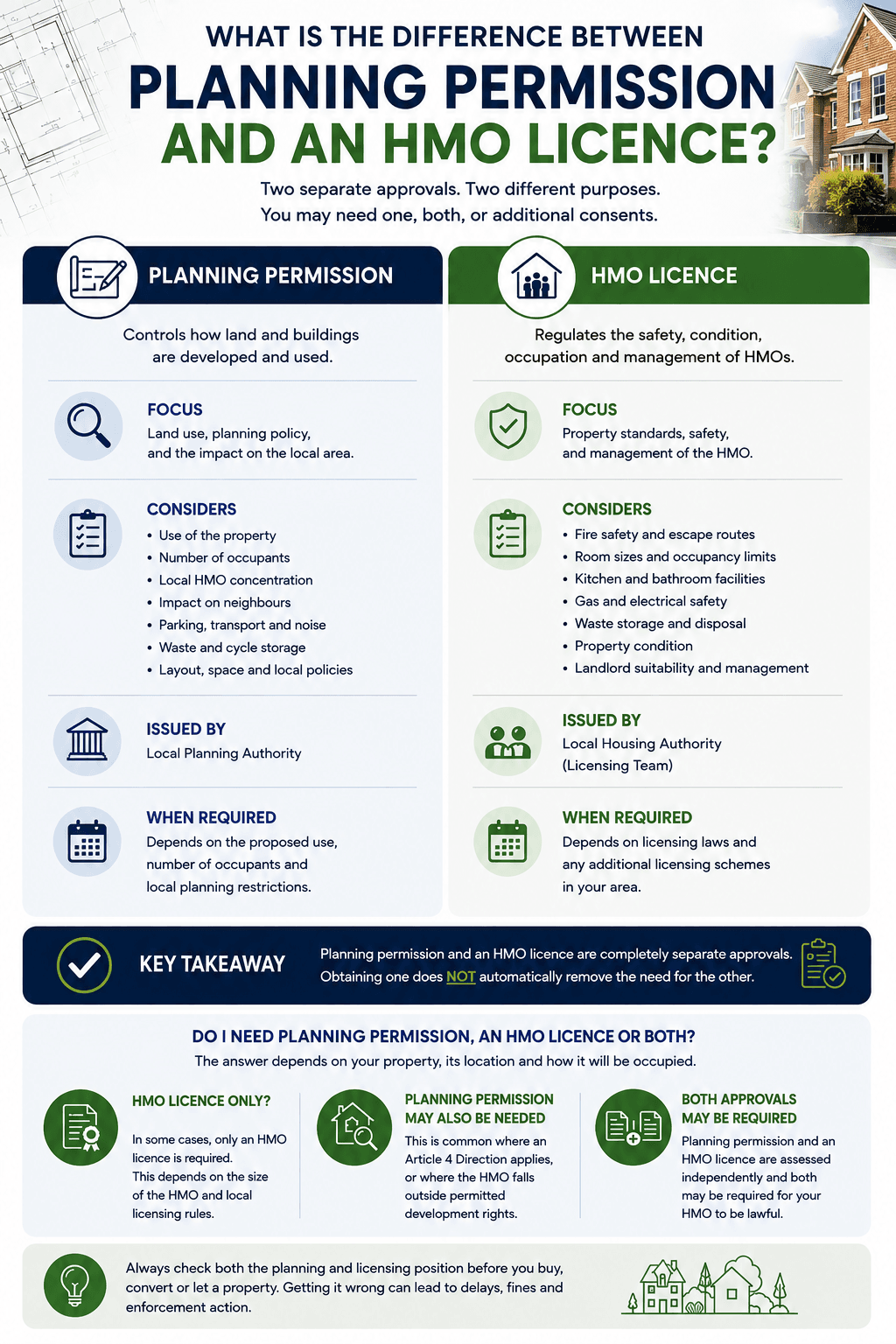
Key Takeaway
Planning permission and an HMO licence are two completely separate approvals.
Depending on the property and its location, you may need planning permission, an HMO licence, both approvals or, in some cases, additional consents before you can legally operate an HMO.
Obtaining one approval does not automatically remove the need for the other.
Do I Need Planning Permission, an HMO Licence or Both?
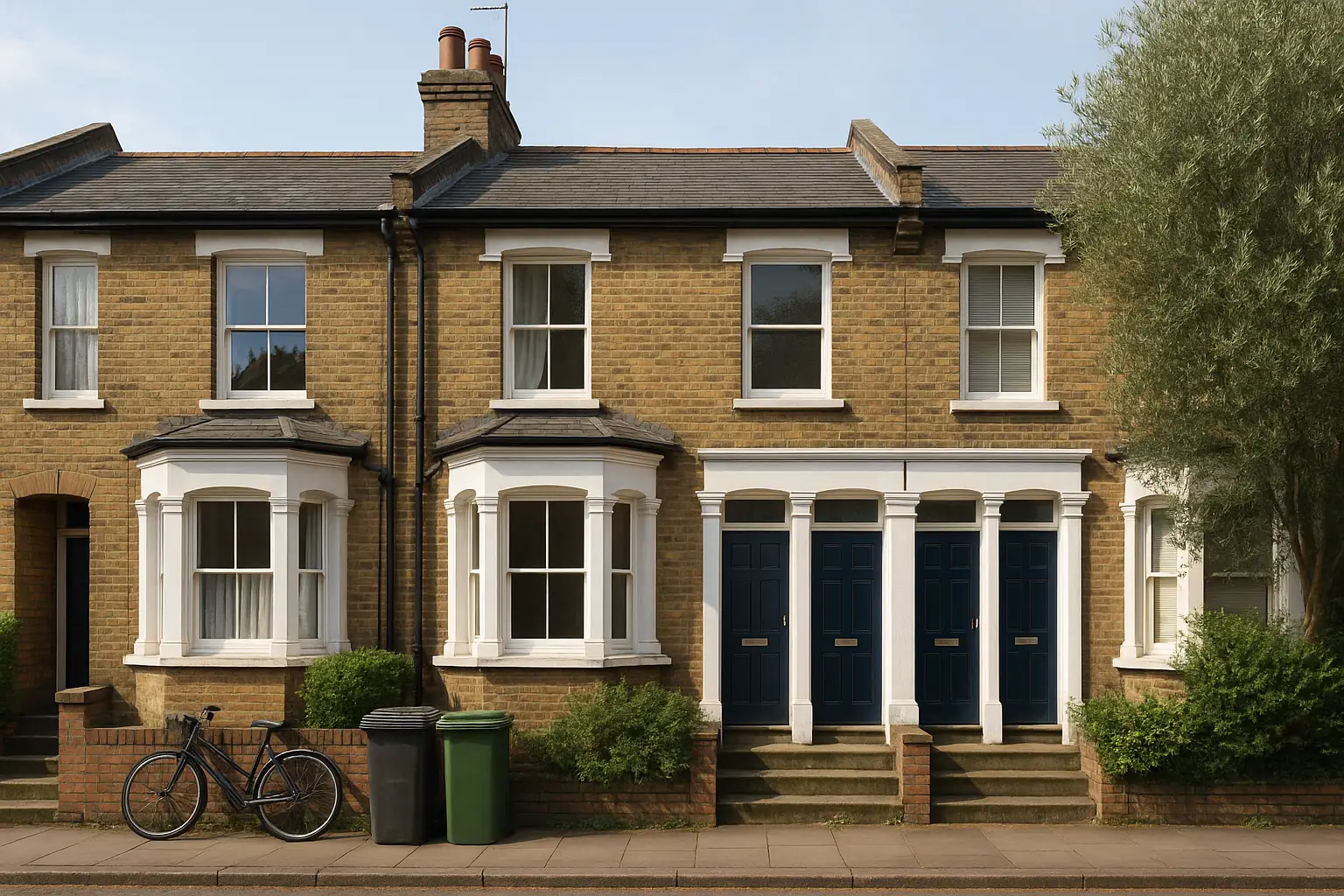
In some cases, a landlord may only require an HMO licence.
In others, planning permission may also be necessary, particularly where a property is being converted from a single dwelling into an HMO in an area covered by an Article 4 Direction.
Planning permission is also normally required where a proposed HMO falls outside the small HMO use class or where associated building works require separate approval.
The important point is that planning permission and HMO licensing are assessed independently.
Obtaining planning permission does not automatically mean an HMO licence will be granted. Similarly, obtaining an HMO licence does not confirm that planning permission is unnecessary or that the existing use is lawful.
Landlords should therefore check both the planning and licensing position before:
- Purchasing an HMO investment property
- Converting a family home into shared accommodation
- Increasing the number of occupants
- Carrying out significant alterations
- Advertising rooms to tenants
- Entering into tenancy agreements
Seeking professional advice at an early stage can help identify potential problems before substantial money is committed to the project.
When Is Planning Permission Required for an HMO?

Changing a Dwellinghouse to a Small HMO
A conventional dwellinghouse occupied by a single household normally falls within Use Class C3.
A small HMO occupied by between three and six residents can fall within Use Class C4. The statutory definition of Class C4 covers the use of a dwellinghouse by no more than six residents as an HMO.
In many areas, a change from Use Class C3 to Use Class C4 can take place under permitted development rights without a full planning application.
However, this should never be assumed without checking the local planning position.
Article 4 Directions
A Local Planning Authority can introduce an Article 4 Direction to remove specific permitted development rights.
Where an HMO Article 4 Direction applies, planning permission will generally be required to change a property from a dwellinghouse within Use Class C3 to a small HMO within Use Class C4.
Article 4 Directions are particularly common in areas where councils are concerned about high concentrations of HMOs and their effect on local communities.
The direction may cover:
- An entire local authority area
- Particular wards
- Specific streets
- Defined neighbourhoods
Landlords should therefore check the precise geographical boundary of any Article 4 Direction rather than relying on general information about the council area.
Larger HMOs
HMOs occupied by more than six residents generally fall outside Use Class C4 and are commonly treated as a Sui Generis use.
Planning permission will normally be required to change a dwellinghouse or small HMO into a larger HMO.
The Local Planning Authority will consider the proposal on its individual merits, taking account of matters such as:
- The scale and intensity of occupation
- The number and concentration of existing HMOs
- The effect on neighbours
- Noise and disturbance
- Parking pressure
- Refuse and recycling arrangements
- Cycle storage
- Internal living conditions
- The character of the surrounding area
Increasing an existing HMO from six to seven occupants can therefore have significant planning implications, even though the physical changes to the property may appear relatively minor.
Building Works
Planning permission may also be required for physical alterations associated with an HMO conversion.
These could include:
- Extensions
- Loft conversions
- New entrances
- External staircases
- Significant changes to windows or doors
- Outbuildings
- Changes within a Conservation Area
- Alterations affecting a Listed Building
Building Regulations approval may also be required separately.
When Is an HMO Licence Required?
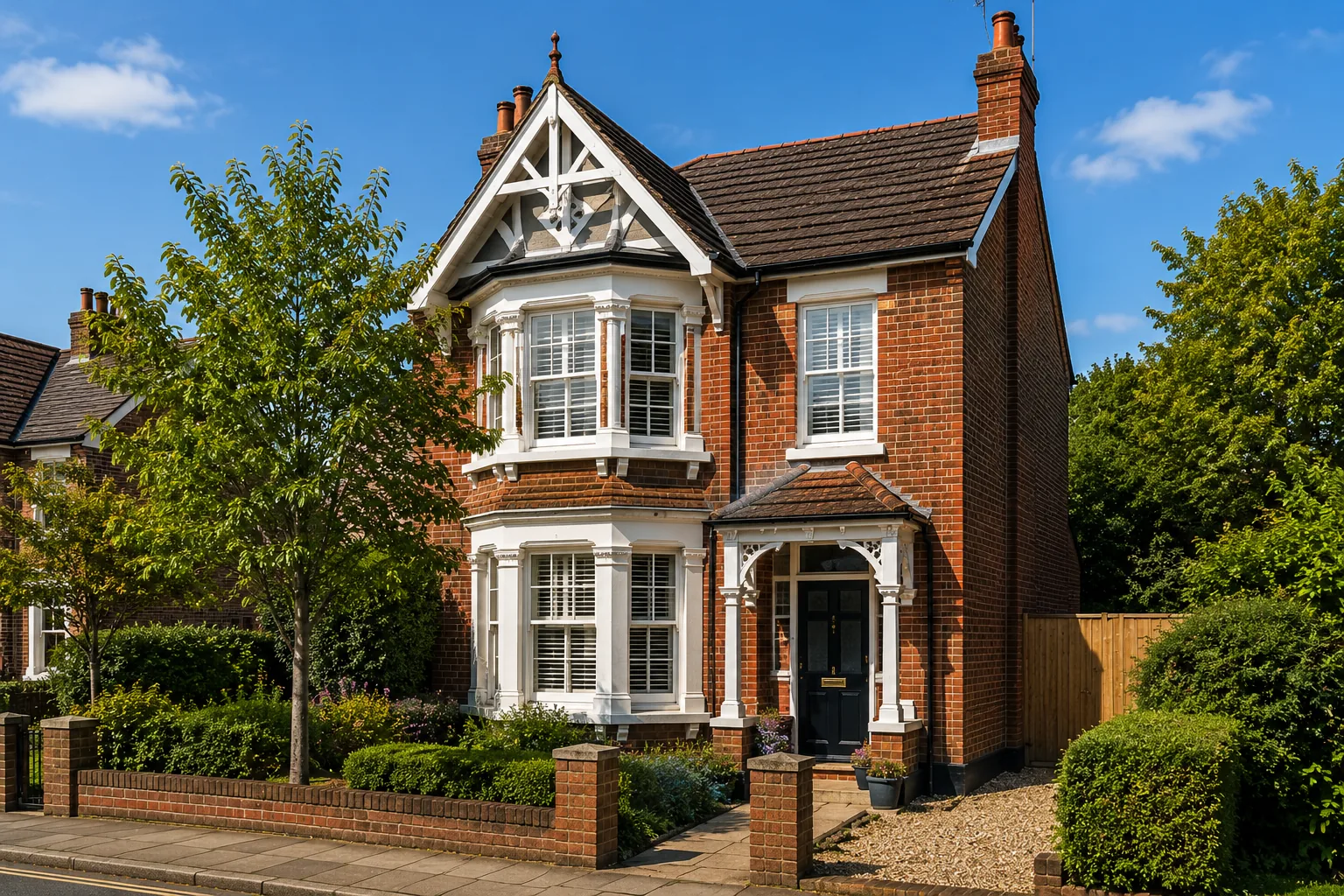
Mandatory HMO licensing in England generally applies to properties occupied by five or more people forming two or more households, subject to the relevant statutory conditions and exemptions.
However, councils can introduce additional licensing schemes that extend licensing requirements to other HMOs, including some properties occupied by three or four people.
This means two apparently similar properties located in different council areas may face different licensing requirements.
A landlord should confirm:
- Whether the property meets the legal definition of an HMO
- Whether mandatory licensing applies
- Whether the council operates an additional licensing scheme
- Whether the property falls within the geographical area covered by that scheme
- Whether any exemptions apply
- What local standards and licence conditions must be met
The licensing authority may inspect the property and consider whether it is reasonably suitable for the proposed number of occupants.
It may also impose conditions concerning:
- Fire detection and alarm systems
- Emergency lighting
- Escape routes
- Bedroom occupancy
- Kitchen and bathroom provision
- Gas and electrical certificates
- Waste storage
- Property maintenance
- Management arrangements
The maximum number of occupants permitted by an HMO licence may not necessarily match the number authorised under planning law.
This is another reason why the two approval processes must be considered together.
Can Planning Permission Be Granted but an HMO Licence Be Refused?
Yes.
Receiving planning permission does not guarantee that a property will satisfy HMO licensing requirements.
For example, planning permission may be granted for a change of use to an HMO, but the licensing authority could refuse the licence or restrict occupancy because:
- Bedrooms fail to meet minimum size requirements
- Fire safety measures are inadequate
- Kitchen or bathroom facilities are insufficient
- The property is unsuitable for the proposed number of occupants
- Management arrangements are inadequate
- The proposed licence holder is not considered a fit and proper person
- Required safety certificates have not been provided
Planning permission confirms that the use is acceptable in planning terms.
It does not certify that the property complies with licensing standards or that it can immediately be occupied by the maximum number of tenants proposed.
Can an HMO Licence Be Granted but Planning Permission Be Refused?
Yes.
This is one of the most common areas of misunderstanding.
A council’s licensing team may determine that a property meets the relevant housing standards and is suitable to be licensed.
However, the Local Planning Authority could still refuse planning permission because:
- The area already has an excessive concentration of HMOs
- The proposal conflicts with local planning policy
- The use would harm the character of the neighbourhood
- Parking pressure would become unacceptable
- Waste storage arrangements are inadequate
- The proposal would cause unacceptable noise or disturbance
- The accommodation would provide poor living conditions
- The proposed external alterations are unacceptable
An HMO licence does not override planning legislation.
Similarly, the fact that the licensing team has accepted an application does not necessarily prove that the use has planning permission or is otherwise lawful.
The two council departments may also assess applications on different timescales and using different legal tests.
What Happens If You Have an HMO Licence but No Planning Permission?
Where planning permission is required but has not been obtained, the Local Planning Authority may investigate the use and consider planning enforcement action.
Depending on the circumstances, the owner may be required to:
- Submit a retrospective planning application
- Reduce the number of occupants
- Stop using the property as an HMO
- Comply with an enforcement notice
- Appeal against an enforcement decision
- Provide evidence that the use is already lawful
A retrospective application is not guaranteed to succeed simply because the property already operates as an HMO or has been granted a licence.
The council will assess the planning merits of the use in the same way as it would assess a proposed development.
This can create a particularly difficult position where tenants are already living in the property.
Confirming the planning position before occupation begins is therefore usually far safer than attempting to regularise an unauthorised use later.
Common Mistakes to Avoid

Assuming an HMO Licence Grants Planning Permission
A licence regulates the condition and management of the property. It does not automatically authorise the use under planning law.
Assuming Planning Permission Removes the Need for a Licence
Planning permission does not replace mandatory or additional HMO licensing requirements.
Ignoring Article 4 Directions
A C3 to C4 conversion that may be permitted development in one location could require a full planning application in another.
Relying Only on the Existing Licence
An existing HMO licence does not necessarily confirm the property’s lawful planning use or guarantee that a future licence will be issued on identical terms.
Increasing Occupancy Without Planning Advice
Increasing the number of residents from six to seven may move the property outside Use Class C4 and create a Sui Generis planning use.
Assuming Every Council Uses the Same Rules
Planning policies, Article 4 Directions, additional licensing schemes and HMO standards vary between local authorities.
Purchasing Before Completing Checks
A property marketed as an HMO investment may still have unresolved planning, licensing, Building Regulations or enforcement issues.
Appropriate due diligence should be completed before contracts are exchanged.
How Planning By Design Can Help
Understanding the relationship between planning permission and HMO licensing can be challenging, particularly where an Article 4 Direction or complex planning history applies.
Planning By Design’s award-winning Chartered Town Planners can assist with:
- Establishing the existing lawful use of a property
- Assessing whether planning permission is required
- Checking Article 4 Directions
- Reviewing local HMO planning policies
- Preparing change-of-use applications
- Preparing applications for larger Sui Generis HMOs
- Advising on occupancy increases
- Providing pre-planning advice
- Preparing planning statements and supporting evidence
- Responding to planning enforcement investigations
- Preparing retrospective planning applications
- Advising on planning appeals
Our team can also work alongside architects, licensing specialists and other professionals to help ensure that the planning strategy is considered as part of the wider HMO project.
With more than 900 successful planning approvals, Planning By Design has extensive experience helping property owners, landlords and developers navigate the planning system.
Conclusion
Planning permission and an HMO licence are often confused, but they regulate entirely different aspects of an HMO.
Planning permission considers whether the use of the property is acceptable in land-use planning terms.
An HMO licence focuses on whether the property is safe, properly managed and suitable for its occupants.
Depending on the property, its location and the proposed number of residents, you may need planning permission, an HMO licence, both approvals or additional consents before the HMO can lawfully operate.
Checking the position at the beginning of a project can help prevent costly delays, unsuccessful applications and enforcement problems later.
Need Professional Advice?
If you are unsure whether your property requires planning permission, an HMO licence or both, Planning By Design can help.
Contact our award-winning team at Planning By Design for a free, no-obligation consultation. Our Chartered Town Planners can assess your proposal, identify the planning approvals you may need and help you choose the most appropriate route forward.
Frequently Asked Questions
Is an HMO Licence the Same as Planning Permission?
No. An HMO licence regulates the safety, condition, occupancy and management of the property. Planning permission determines whether its use as an HMO is acceptable under planning law.
Do All HMOs Need Planning Permission?
No. Some changes from a dwellinghouse within Use Class C3 to a small HMO within Use Class C4 can take place under permitted development rights. However, planning permission may be required where an Article 4 Direction applies, for a larger HMO or where the proposed change is otherwise considered a material change of use.
Do All HMOs Need an HMO Licence?
No. Mandatory licensing generally applies to HMOs occupied by five or more people forming two or more households. However, local additional licensing schemes may require smaller HMOs to be licensed.
Do I Need Planning Permission to Convert a House into an HMO?
It depends on the number of proposed occupants, the existing lawful use of the property and whether an Article 4 Direction applies. Larger HMOs and some small HMOs will require a planning application.
What Is an Article 4 Direction?
An Article 4 Direction allows a Local Planning Authority to remove specified permitted development rights. For HMOs, it commonly means that planning permission is required to change a dwellinghouse within Use Class C3 into a small HMO within Use Class C4.
Can I Operate an HMO with Planning Permission but No HMO Licence?
Not where an HMO licence is legally required. Planning permission does not replace licensing requirements.
Can I Obtain an HMO Licence Without Planning Permission?
A licensing application may sometimes be processed even where the planning position has not been resolved. However, obtaining a licence does not make the use lawful under planning legislation where planning permission is required.
Is Planning Permission Required for a Seven-Person HMO?
A property occupied by more than six residents will generally fall outside Use Class C4 and is commonly treated as Sui Generis. Planning permission will normally be required for a material change to that use.
Can I Increase the Number of Occupants in an Existing HMO?
Possibly, but you should check both the planning permission and the HMO licence. Increasing occupancy may require a planning application, a licence variation, additional facilities or safety works.
Can Planning By Design Help with an HMO Planning Application?
Yes. Our Chartered Town Planners can advise on planning strategy, Article 4 Directions, change-of-use applications, larger HMOs, retrospective applications, enforcement matters and planning appeals.

A versatile and resilient Chartered MRTPI Town Planner with private and public sector experience. Aaron has a deep understanding of the planning process as both the applicant and local planning authority. Whether small scale residential or large scale commercial developments his expertise ensures the best advice and robust planning applications.
Need Planning Advice? Get a Free Consultation.
Contact UsGet a Free Instant Estimate!
Cost Calculator


