
Planning application fees in England are set to increase from 8 December 2026, with another inflation-linked rise due on 1 April 2027. The new planning fees would affect homeowners, developers and businesses, although the size of the increase will depend on the application type.
For homeowners, developers and businesses considering a planning application, the timing of submission could therefore make a meaningful difference to the overall cost of a project.
The proposed December 2026 planning fee increase does not apply a single percentage uplift to every application. Instead, the Government has created a new national default fee schedule intended to recover approximately 90% of the estimated cost of processing different application types. As a result, some planning application fees would rise relatively modestly, while others would increase by more than 50%.
Want to avoid the December planning fee increase?
Start preparing your application now. Applicants should allow at least one month for drawings, planning statements, revisions and final approval before submission. Some proposals also require third-party reports that can take several weeks to prepare.
An application cannot normally be prepared the day before the deadline. Contact Planning By Design as early as possible if you are hoping to submit before 8 December 2026.
When are planning application fees changing?
The new national default fees are expected to apply to planning applications made on or after 8 December 2026.
The regulations are currently in draft form and are subject to approval by both Houses of Parliament under the affirmative procedure. Until they are approved and made, the existing fees remain in force.
Under the transitional arrangements, the fee is determined by the date on which the application is submitted not the date on which it is validated or decided. Therefore, an application submitted before 8 December should attract the current fee, even if it is validated or determined later.
The new fees would remain at the December rates until 31 March 2027. They would then be increased in line with inflation from 1 April 2027.
How much are planning application fees increasing?
The impact varies considerably depending on the type and scale of development. Some of the most relevant proposed changes include:
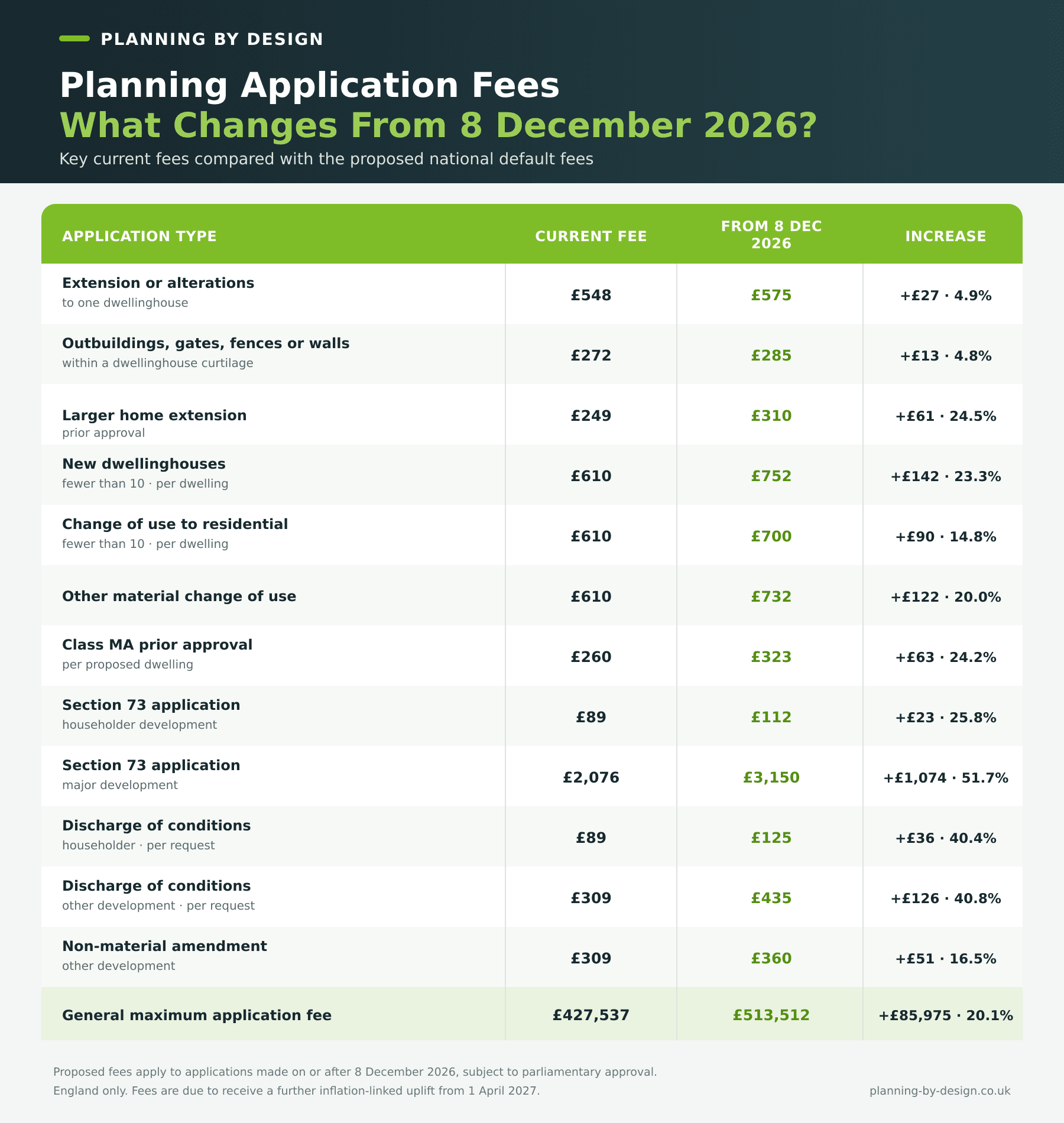
The general maximum planning application fee is also proposed to rise from £427,537 to £513,512, an increase of approximately 20%.
The figures above apply to England and are based on the draft national fee schedule. The correct fee should always be confirmed before submission.
A new £310 charge for previously free prior approval applications
One of the most significant structural changes is a new £310 fee for prior approval applications that currently attract no charge.
Existing charged prior approval routes would also rise. For example, larger home extension applications would increase from £249 to £310, while Class MA applications for changing commercial premises to residential use would rise from £260 to £323 for each proposed dwelling.
Applicants relying on permitted development rights should therefore not assume that prior approval will remain a low-cost or free route. The particular permitted development class and the correct fee will need to be checked carefully.
Why are the fees increasing?
The Government says that no existing planning application fee fully covers the cost incurred by local planning authorities when determining applications. Its evidence identified shortfalls of between 18% and 60%, with Section 73 applications for major development and applications to discharge planning conditions among the categories most frequently considered underpriced.
The proposed national schedule is intended to recover around 90% of estimated processing costs. The Government argues that the additional income should help improve local authority capacity and support a more efficient planning service.
However, planning fee income is not currently ring-fenced for planning departments. Higher fees therefore do not automatically guarantee faster validation or determination. Applicants will still need to ensure that submissions are accurate, complete and supported by the correct technical information to reduce the risk of avoidable delays.
Are planning fees increasing again in April 2027?
This means applicants could face two increases within less than four months:
- the introduction of the new national default fee schedule on 8 December 2026
- an inflation-linked increase on 1 April 2027
Projects scheduled for 2027 should therefore treat the proposed December figures as a baseline rather than a guaranteed final cost.
Could councils charge even more?
Potentially. The Planning and Infrastructure Act 2025 contains powers that could allow local planning authorities to set their own fees. Separate regulations are expected, under which councils may be permitted to charge up to 30% above the national default where higher costs can be evidenced and justified.
The Government has also consulted on an additional surcharge, expected to be around 10% of the national default fee, to support statutory consultees.
These measures are separate from the December fee regulations and are not yet in force. Nevertheless, they indicate that planning application costs may become more locally variable in the future.
Aaron Basi: “Early preparation will matter more than ever”
“Applicants should allow at least one month to prepare the drawings, planning statements and supporting documents. While we aim to complete this work within two weeks where possible, revisions and client feedback can add time before everything is approved and ready for submission.
“Some proposals may also require specialist reports covering matters such as ecology, transport, drainage, heritage or trees. These can take weeks or even months to obtain and may be required before submission.
“Anyone hoping to avoid the December fee increase should therefore begin the process now. Leaving it until the deadline is approaching may mean there is simply not enough time to prepare a complete and properly supported application.”
— Aaron Basi, MRTPI, Head of Town Planning at Planning By Design
Should you submit before 8 December 2026?
Where a proposal is sufficiently developed and a valid application can be prepared in time, submitting before 8 December could secure the existing statutory fee. This may produce a meaningful saving, particularly for larger schemes or applications involving multiple dwellings.
However, the submission date should not be considered in isolation. Before applying, applicants should confirm:
- the correct application route
- whether the proposal may constitute permitted development
- the local authority’s validation requirements
- which drawings, reports and assessments are required
- whether pre-application advice would be beneficial
- the correct fee and method of calculation
Submitting a complete, well-prepared application remains more important than submitting an inadequate scheme purely to avoid a higher fee.
What is not changing?
The draft regulations retain several existing exemptions and concessions. Listed Building Consent would remain free, as would applications for works to protected trees and qualifying works for disabled access. The 50% concession for parish and community councils would also remain.
No application fee is being introduced for planning appeals in England, and the Government has decided not to reinstate the former “free go” for repeat applications.
Planning an application in late 2026 or 2027?
With a major fee restructuring expected in December, a further inflation-linked rise in April and possible locally set fees on the horizon, budgeting and early preparation are becoming increasingly important.
Planning By Design can review your proposal, identify the most appropriate application route and prepare a robust submission that meets the relevant planning and validation requirements.
Planning to submit before 8 December 2026? Start your application now to allow sufficient time for drawings, supporting documents and any specialist reports.
Contact Planning By Design’s award-winning team for a free, no-obligation consultation.
Frequently Asked Questions About Planning Application Fees 2026
Are planning application fees increasing in 2026?
Yes. Planning application fees in England are set to change on 8 December 2026, subject to the draft regulations receiving parliamentary approval. The increase varies by application type rather than applying as one flat percentage.
When do the new planning fees start?
The draft regulations specify 8 December 2026. They must first be approved by both Houses of Parliament and made into law.
What are the new planning application fees from December 2026?
Examples include £575 for alterations or an extension to one dwellinghouse, £752 per dwelling for developments of fewer than 10 new homes, £310 for a larger home extension prior approval application and £3,150 for a major development Section 73 application. Fees vary by development type and scale.
How much is a householder planning application fee in 2026?
The fee for alterations or an extension to one dwellinghouse is currently £548 and is proposed to increase to £575 from 8 December 2026. Works within the curtilage of a dwellinghouse, such as certain outbuildings, gates, fences or walls, would increase from £272 to £285.
How much will prior approval applications cost from December 2026?
Many prior approval applications currently charged at £249 would rise to £310. Class MA prior approval would increase from £260 to £323 per proposed dwelling. Previously free prior approval applications would attract a new £310 fee.
How much will a Section 73 application cost in 2026?
From 8 December 2026, the proposed Section 73 fee is £112 for householder development and £3,150 for major development. The £608 fee for non-major development is expected to remain unchanged in cash terms in December.
How much will it cost to discharge planning conditions?
The proposed fee from 8 December 2026 is £125 per request for householder development and £435 per request for other development, including a condition relating to a Biodiversity Gain Plan.
Which planning application fee applies if I submit before 8 December 2026 but validation happens later?
Under the proposed transitional arrangements, the relevant date is the date the application is made, rather than the validation or decision date. An application made before 8 December should therefore attract the current fee.
Will all planning application fees increase by the same percentage?
No. The proposed fees are based on approximately 90% of the estimated cost of processing each application type. Percentage increases therefore vary substantially.
Are planning fees increasing again in April 2027?
Yes. The new national default fees are due to receive their first annual inflation-linked uplift on 1 April 2027.
How much will planning application fees increase in April 2027?
The precise increase is not yet known. It will be based on September 2026 CPI and capped at 10%.
Can local councils set their own planning application fees?
Not under the December regulations alone. However, separate regulations are expected to enable local planning authorities to set fees above the national default where higher costs can be evidenced and justified. Applicants should check the fee with the relevant authority before submitting.
Is there a fee for a planning appeal in England?
No planning appeal fee is being introduced as part of these changes. Other professional or procedural costs may still arise when preparing an appeal.
Do the changes apply throughout the UK?
No. The proposed fee schedule applies to planning applications in England.
Will Listed Building Consent still be free?
Yes. The draft regulations retain the existing exemption for Listed Building Consent.
Is there still a free resubmission of a planning application?
No. The former “free go” for repeat planning applications was abolished in December 2023, and the Government has decided not to reinstate it or introduce a reduced resubmission fee.

A versatile and resilient Chartered MRTPI Town Planner with private and public sector experience. Aaron has a deep understanding of the planning process as both the applicant and local planning authority. Whether small scale residential or large scale commercial developments his expertise ensures the best advice and robust planning applications.
Need Planning Advice? Get a Free Consultation.
Contact UsGet a Free Instant Estimate!
Cost Calculator


