Proposed Use or Development
For work or a use that has not yet begun. This can help establish whether a clearly defined proposal would be lawful, for example under permitted development rights.
Application support for proposed and existing lawful development.
A Lawful Development Certificate, or LDC, confirms that the use or development described in it is lawful for planning purposes. Planning By Design helps assess the relevant route and prepare a precise application with drawings and supporting evidence.
For work or a use that has not yet begun. This can help establish whether a clearly defined proposal would be lawful, for example under permitted development rights.
For an existing use, completed works or certain breaches of condition. The application needs evidence supporting the claimed lawfulness at the relevant date.
In England, these are commonly described as section 192 and section 191 applications respectively. The guidance below concerns England; the applicable process must be checked for other UK nations.
Professional planning advice for your project.
Architects and town planners working together.
Advice tailored to the site and local context.
Know the services included in your quotation.
The authority assesses the facts and relevant planning law. An LDC is not an assessment of whether it likes the design or considers the proposal desirable.
The description and plans must clearly identify what is being certified. A certificate for one arrangement should not be treated as covering a different project.
The applicant must supply enough information. For an existing use, precise and consistent evidence can be crucial to demonstrating the position.
A planning certificate does not replace Building Regulations approval, listed building consent or other permissions and property rights that may be relevant.
Our Planning Appraisal can help establish whether an LDC is an appropriate next step. We review the proposal and available history, explain information gaps and identify whether a different application may be needed. A professional opinion is separate from the authority’s formal certificate.
Planning Appraisal effectively becomes FREE if you proceed with any further Planning By Design service.
The appraisal fee is deducted from your quote/invoice, including if you proceed with drawings only.
The evidence needed depends on whether the application concerns a proposal or an existing situation.
The site address, previous decisions, approved plans, conditions, certificates and any enforcement correspondence.
Location and site plans, layouts, elevations and dimensions as appropriate to the particular claim or proposed works.
Dated photographs, records, plans and witness evidence may be relevant. We assess what is available and whether it addresses the period and use claimed.
A structured explanation connecting the facts, drawings and evidence to the basis on which the certificate is sought.
Do not rely on a blanket “four-year rule”. In England, ten-year enforcement periods apply to operational development substantially completed on or after 25 April 2024 and to changes to a single dwellinghouse occurring on or after that date. Earlier cases may fall within transitional rules; other breaches generally have a ten-year period.
Exceptions and enforcement history can affect the position. The age of a structure alone does not establish a successful claim. Share the full timeline and any notices so the relevant tests can be assessed.
Tell us whether the work is proposed or already exists. Send the address, plans, relevant dates and council correspondence.
Review the available information and identify the route, evidence requirements and any issues that need further investigation.
Prepare the agreed drawings and supporting explanation, bringing together the evidence supplied for your review.
With your approval, submit the application and supporting documents. Liaise with the authority within the agreed scope.
Review the outcome and exact description, plans and limitations. Discuss next steps if the certificate is refused or the proposal changes.
Allow time to gather the evidence and prepare accurate drawings before submission. Existing-use cases can take longer where records are incomplete. In England, the usual determination period is eight weeks for an LDC application; information requests or agreed extensions can affect the programme.
Our fees depend on the complexity of the claim, drawings and supporting work. Application fees and separately commissioned specialist input are additional where applicable. We confirm the scope in your quotation. Our Price Match Guarantee applies to genuine like-for-like quotations.
A clear application records the proposed dimensions, layout and use so that the planning position relates to a specific scheme.
A certificate can help answer planning-status questions during a future sale or remortgage. Keep it with the associated plans and supporting property documents.
An LDC is not generally compulsory, but it can provide greater certainty than relying on an informal opinion. Changes to the proposal or relevant circumstances may need a fresh assessment.
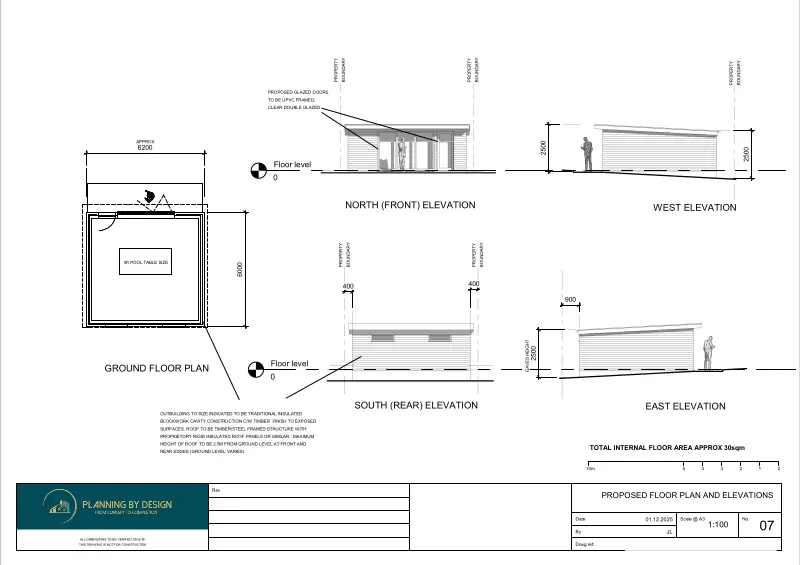
The client approached Planning By Design about a detached domestic outbuilding in the rear garden. Following a planning appraisal, our team recommended a Lawful Development Certificate for the proposed games room.
Our architectural team prepared the drawings, and our town planners prepared a supporting Planning Statement addressing the permitted development requirements. The application was submitted with the client’s approval, and the certificate was granted.
We consider the legal planning basis alongside the information available.
The drawing scope is tailored to the proposal or existing development being assessed.
Know which documents and application services you are commissioning.
We explain gaps and risks without assuming that a certificate will be granted.
Architectural and planning input can be brought together where needed.
Understand the decision and what it means for the specific development described.
No. It formally confirms lawfulness for planning purposes. It does not grant a new discretionary permission for a proposal that does not meet the relevant legal tests.
It is not generally mandatory, but applying before work begins can provide formal confirmation for a specific proposal. We can assess whether it is an appropriate step for your project.
An existing-development application may be appropriate. The relevant basis, dates and evidence must be assessed; completed work does not automatically qualify.
This wording is often used for a certificate dealing with the use of land or buildings. It sits within the lawful development certificate framework rather than being a separate guarantee of permission.
There is no statutory neighbour consultation requirement for an LDC. The authority may seek factual evidence, including from neighbours; the decision concerns lawfulness rather than the planning merits of objections.
The evidence should establish the use and relevant timeline clearly. Records, dated photographs, plans and statements may assist. We will discuss the evidence needed for your specific claim.
Not as a general rule in England. Changes from 25 April 2024 and transitional provisions mean the type of development and relevant dates must be checked. Do not assume that four years makes development lawful.
It can provide formal planning-status evidence, but it does not replace the wider checks made by your solicitor or lender. Their requirements depend on the transaction.
Review the reasons. Further evidence, a different application or an appeal may be appropriate. A refusal can reflect insufficient evidence; it does not always settle every question about lawfulness.
No. Building Regulations and other relevant approvals must be considered separately. Tell us which technical stages you need so these can be clearly scoped.
Planning updates, guidance and answers from Planning By Design.
Send the property details, your plans or the history of existing work. We will help identify the appropriate next step.